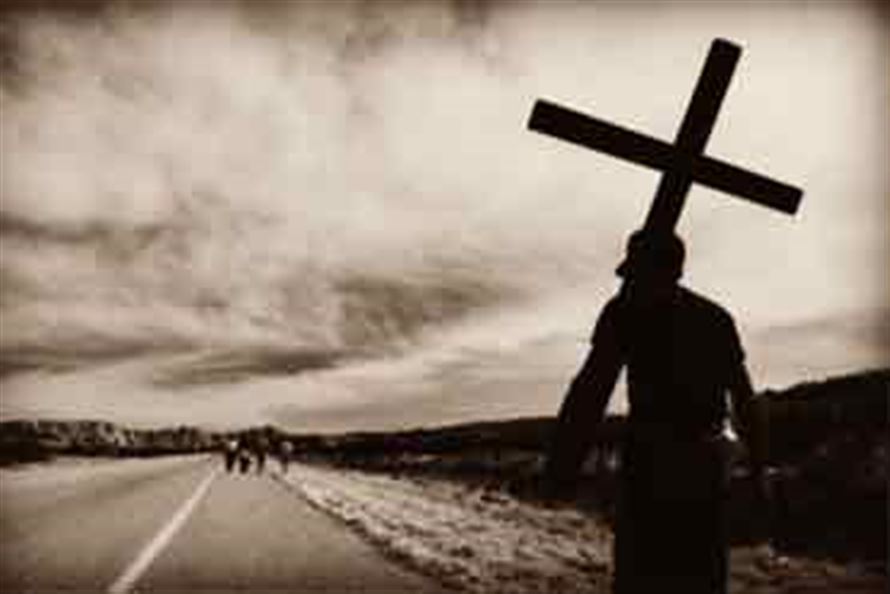
Way of the Cross 2025
This annual Way of the Cross gathered hundreds, young and old, to step together through the narrative of the Passion, and to allow, in the words of Luigi Giussani, the “event of Christianity” to confront them anew.The wide green sweep of Phoenix Park became for a few solemn hours the locus of a simple and searching reality: a people accompanying Christ on his way. From the Wellington Monument to the great Papal Cross the procession moved not as an act of nostalgia but as an insistence, an insistence that the truth of the Cross remains a living claim upon our lives and our city. This annual Way of the Cross, organised by Communion and Liberation in Ireland, gathered hundreds, young and old, to step together through the narrative of the Passion, and to allow, in the words of Luigi Giussani, the “event of Christianity” to confront them anew. 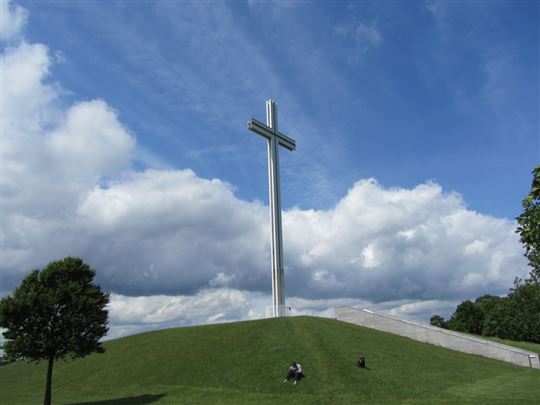
There is something decisive about public witness. To stand beneath the open sky and follow the stations as a visible body is to say that faith is not merely private consolation but a public transformation. In the architecture of belief we are often tempted to domesticate the Cross: make it tasteful, abstract, or confined to cathedral vaults. But the image of a cross rising against the Irish sky, and a crowd moving toward it with measured steps and spoken prayer, undoes domestication. It reintroduces struggle, paradox, and the scandal of suffering into the center of our attention, which, paradoxically, is where the possibility of new life first appears.
The route itself carries a kind of theology. The Wellington Monument stands as a memorial to worldly victories; the Papal Cross, erected for a papal visit, is a symbol of ecclesial presence in the public square. Walking from one to the other, stopping at stations that recall humiliation and endurance, we enact a journey that refuses to separate the civic and the sacred. The procession suggests that the Christian story does not hover above civic life as a decorative theme: it enters streets, parks, institutions, families, and bodies. It claims them.
What moved many who participated was not only the choreography of ritual, but the educational encounter it provoked. Giussani taught that Christianity is first of all an event that educates the human heart by meeting it, that faith is not merely assent to propositions but a sustained experience of a presence. Walking the Way of the Cross makes that pedagogy tangible: at each station a short meditation, a sung refrain, a pause of silence, these are not ornaments but means by which hearts are reoriented. The young people who came, many drawn by the invitation of local communities and the movement’s students, found in the simplicity of the prayers a grammar for seeing suffering differently: not as meaningless waste, but as the soil in which new compassion and courage may grow.
A question that often surfaces in such public acts: what is the point of slow ritual in a world that prizes speed and utility? The answer is precisely that the slow and the communal reveal the shape of reality that speed effaces. The procession slows the eye and stalls the hurry of commerce and distraction. The voice that reads the meditations, the choir that rises at a station, the ordinary person who carries the cross for a stretch, all teach, by repetition and presence, that the human heart needs more than information; it needs formation. Formation arrives when the mind is invited to dwell, when the body is engaged, and when memory is communal. There was rain that day, a detail which, once more, refused to sentimentalise the scene. Rain did not deter the crowd; it baptized it. To stand beneath grey skies, to feel the wind, to keep walking, is to inhabit not an idealised Christianity but one that is at home with weather and with history. The Irish Echo’s images remind us that devotion on a public day is not a private warmth protected from the elements but a material fidelity that keeps its feet on grass and its gaze on the cross.
Theologically, the stations are an exercise in attention. Each moment of the Passion is not a detached moment in the past but an instance that opens toward the present. That conviction is what gives the procession its urgency: the Passion speaks into our context, into loneliness, injustice, grief, and fear, and wrests from those realities an invitation to solidarity and conversion. For those who listened to the meditations of Giussani, the words were not abstract commentary but invitations to recognise where Christ’s path intersects their own: in the hospital corridors, in the classroom, in the kitchen where a young mother worries, in the cell where a man repents.
There is also a pedagogical courage in inviting the city to watch. Public liturgy risks misunderstanding; it invites curiosity, critique, and sometimes mockery. Yet there is bravery in making the cross visible in the civic commons. It is a gentle refusal to accept the privatisation of belief and an insistence that truth must be offered, even at the cost of being misunderstood. When faith becomes visible, it subjects itself to the test of conversation and encounter; it allows its claims to be answered by the world it hopes to transform.
In the midst of this, the voice of the choir, the breathing together in song. deserves special notice. Communion and Liberation’s musical accompaniment does more than beautify; it forms a common memory. Song threads the procession, carrying phrases of lament and hope so that participants find words when they might have none. Music, in such moments, becomes a theological agent: it shapes response, channels sorrow, and, in the density of communal voice, makes room for consolation.
There is in contemporary preaching a habit of reducing the Cross to either moral lesson or patriotic metaphor. But the stations resist such reduction. They insist that the Cross be contemplated with both reverence and realism. The story of humiliation and death is told in a way that resists sentimental flattening, calling instead for a recognition of the suffering that remains unresolved in our world. In that recognition, however, there is hope: the Cross is not an endpoint but a hinge. It is the place where the vulnerability of God meets the vulnerability of humanity and where, mysteriously, possibility for change is born.
For the many young people who came, families with toddlers, the elderly, all covered in many layers to combat what was deemed fitting rain for the day, the procession offered an answer to the hunger for truth and beauty that often goes unarticulated. In an era of fragmentary belonging, the visible fact of the Church walking the park offered a profound lesson: belonging is enacted. The Way of the Cross teaches the rhythm of attention, the discipline of solidarity, and the courage to witness.
It is fitting, finally, to return to the word Giussani used so often: education. To follow the Way of the Cross is to be educated into the logic of presence, the habit of letting oneself be met and changed. This is not a soft call to sentiment but a strenuous invitation to let one’s affections be reordered. If Christianity is an event, then ritual like the Way of the Cross is one of the settings in which that event continues to happen. It thickens reality so that we can see what is often invisible: mercy in small acts, the dignity of those who are ignored, the call to repair what is broken.
As the crowd dispersed beneath the still-visible cross, returning to the city’s shops and workplaces, the work of the stations did not end. The witness had been planted in memory and conversation; it would return, in different forms, into the week that follows. The public act leaves private traces. May such public acts continue to witness with humility and joy to the presence that has the power to redeem our streets, our politics, and our hearts. In a world hungry for meaning, the simple act of walking together, stopping to remember, and lifting our voices in song is not merely an hour marked on the calendar: it is the slow but certain work of formation, the patient labor of making a people who can see and receive the mystery that saves.
