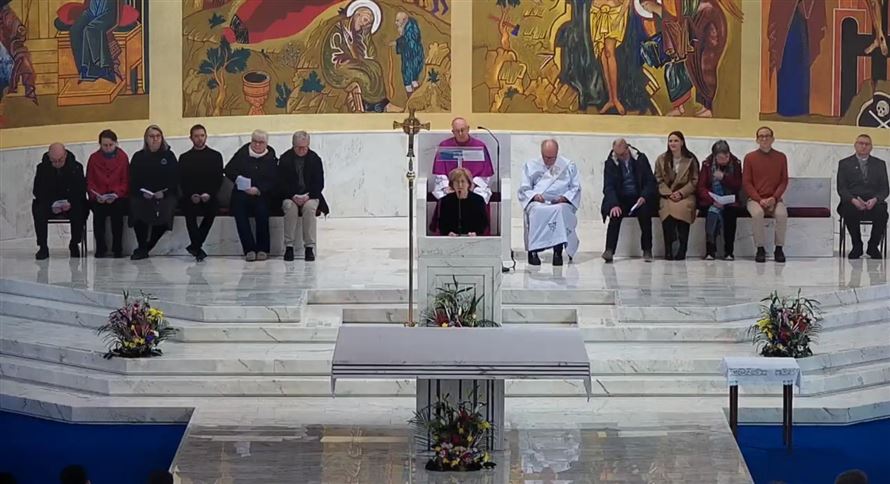
From Rome to Dublin: Prayer for Peace
Inspired by the Jubilee and by Pope Leo’s call to unity and mission, Claudia, responsible for CL in Ireland, wrote to the other lay associations, ecclesial movements, and new communities with the invitation to organise a Prayer for Peace in Dublin.Her letter was simple and exact in its intention: to gather different charisms in one act of prayer, in communion with the Church and in solidarity with one another. The idea itself already carried the memory of Rome in it.
The prayer day was not easy to organise. There were different sensibilities, different ways of praying, different songs, different instincts. But this was not a problem outside the experience; it was the experience. What mattered was not that everyone thought the same, but that everyone remained within the same body. And that is where the beauty came from. The different movements had to listen, compromise, make room, and find a common form of prayer. Unity was not a slogan; it was a task of love.
That is why the day in Dublin was beautiful. It gathered the fruit of Rome into a concrete sign at home. The movements came together following online preparation, the service was led by Bishop Donal Roche.
In his homily, Bishop Roche urged those present not just to pray for peace, but to be builders of peace in their own lives. “To be a peacemaker we have to get into the mind of the other, to understand their situations and to compromise, and to maybe step back a little bit and sacrifice the high moral ground. Maybe there are situations where I refuse to let go of a grudge or forgive somebody who has wronged me and yet I come and pray for peace.”
The coming together of so many movements and communities was a “great display of faith,” he said. “We should not underestimate the power of that prayer.” “Our prayer can be powerful and can be effective by bringing acts of peace and forgiveness and justice about in our own lives. Who knows the effect of our actions on those who observe us.” The Nuncio expressed joy at seeing the movements working together, saying that it made real what the Pope asks of them: to walk together, know one another, accompany one another, support one another, and do things together.
What happened there was modest, but not small. It was the kind of beauty Giussani always seemed to recognise: the beauty of something real, born from obedience to what has been given, and from the willingness to remain inside communion even when it costs something. In that sense, the Prayer for Peace in Dublin was not a separate initiative. It was the continuation of the Jubilee in another place. Rome showed the meaning; Dublin began to show the fruit.
