“Around One Table: A Thanksgiving of Presence”
In a world that often moves too quickly, moments of gratitude can become rare. This article recounts a simple yet deeply meaningful Thanksgiving gathering shared among CLU friendsIn the spirit of Luigi Giussani, the CLU students of our Communion and Liberation community came together one clear evening to do something both simple and decisive: they gave thanks. It was not merely a party, nor a cultural observance borrowed from another land; it was an occasion in which a people recognised themselves as gift, and in that recognition discovered the shape of their mission. The movement itself, Communion and Liberation, felt present not as an abstract program but as a living school, a school that forms hearts by gathering them around a common table.
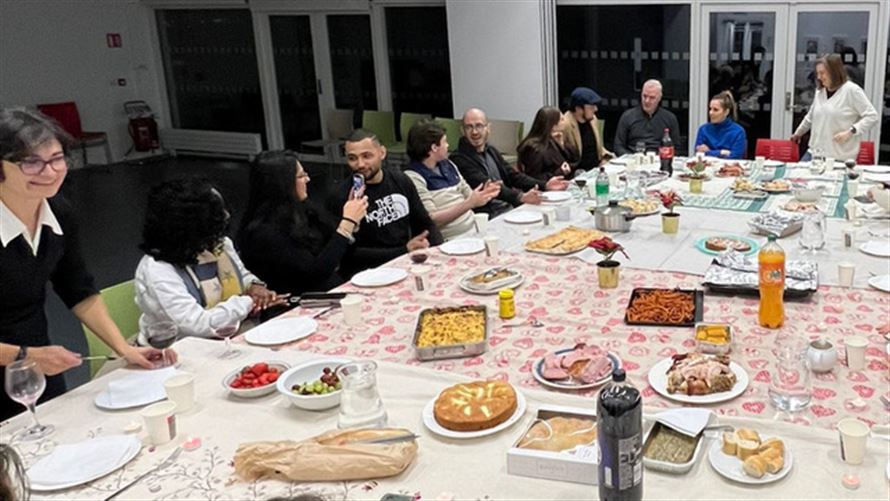
There is something essentially Christian about the simple act of bringing food and breaking it together. We all arrived with parcels and dishes, casseroles warmed in borrowed ovens, salads that smelled of citrus and late summer herbs, pies with caramelised edges, bread torn rather than sliced. The room looked like an offering: mismatched plates, a central table that became an altar in miniature. Students and adults stood side by side; young hands arranged platters while older hands blessed the arrangement with small adjustments, a tuck of napkins, the gentle placing of a bowl. The scene itself taught us at once: hospitality is not an ornament but a school of truth. As Giussani would say, reality, as it really is, educates the heart. We sang. The voices of students, clear, sometimes unsteady, lifted alongside voices that had learned their songs in other seasons of life. Some of the songs were ones we all knew; some were new, caught like sparks from the mouths of those who improvised a verse on the spot. There were solo performances that stopped the room into a holy silence: a guitar, a voice, the brief hush that happens when beauty strips away the habit of taking everything for granted. We are often reminded that beauty is a catechist: it argues without syllogisms and opens a heart’s ear to mystery. That night, the music did precisely that; it exposed our hunger while promising a feast.
Nick, who had crossed an ocean with the tradition of Thanksgiving embedded in his memory, offered a short homily, a friendly, lucid account of the holiday as a practice of remembering God’s providence and human kinship. He did not exoticise the custom nor did he reduce it to mere patriotism; rather, he presented Thanksgiving as a Christian posture with civic fruit: gratitude turns memory into responsibility. He explained the history lightly, then folded that history into the Christian narrative: we remember blessings in order to become instruments of blessing.
When Nick spoke, his words landed with the authority of a witness: an American voice within an Irish room reminding us that traditions travel not to be copied but to be incarnated anew. What moved everyone most was a simple thing: we went around the table, one by one, and each person offered a single articulation of gratitude for the past year. The format lowered the barriers of eloquence, no one needed to give a speech, but it raised the weight of witness. A freshman said she was grateful for a friend who stayed with her through a difficult term; a professor thanked the community for patience and honest critique; a mother expressed gratitude for small reconciliations at home; a shy student whispered thanks for a vocation suddenly visible. With each testimony, faces softened, laughter and tears braided together. The rhythm was evangelical: the inscription of grace in the diary of concrete life.
Giussani taught that Christianity is not an idea to be subscribed to but an event that becomes formative: a living presence that transforms our daily choices. That evening’s testimonies were not abstract confessions but living maps of transformation. Gratitude named not merely things but persons who had been the means of God’s presence. To say “I am grateful for X” in that circle was to declare: here is how God has come to me. And once named, those gifts were not hoarded; the very act of announcing them made them communal, and in being made communal, they increased. What we lived was a liturgy of ordinary life. We brought what we had, our foods, our talents, our stories, and in offering them we tasted the deeper economy of the Gospel: that to give is to receive; that our poverty becomes the seedbed of abundance when given with freedom. This is not sentimentality. It is anthropology informed by grace.The insistence that beauty converts confused hearts into believing ones helps us see why a pie, a song, a spoken gratitude matter: they are channels through which the invisible becomes visible, through which the Eucharistic logic, Christ’s self-gift, is rehearsed in human interchange.
The presence of adults and students together was not incidental. Communion and Liberation has always proposed that faith is transmitted in relations of charity and competence: younger members learn not by abstract instruction but by seeing faith exercised in the fidelity of elders. That evening the older members modeled humility and joy; they trimmed candles, they laughed at the students’ jokes, they listened with real attention. The students, for their part, brought energy, improvisation, and an eagerness to learn how to make a common life. Where these generations met around the table, parents and pupils became in a sense teachers and students together: each one an instance of the Church’s ongoing catechesis.
There was a subtle sacramentality in the work of arranging plates. Each gesture, passing a dish, serving a neighbor, wiping a clasped hand, became a sign. We do not usually name these gestures as sacrament, but they were analogous to sacraments in their capacity to make visible the invisible: charity. In the economy of communion, small acts have eschatological meaning; they are practice for the final feast toward which we journey. We practiced tonight, not because practice substitutes for the Eucharist, but because practice disposes the heart to receive it more fully.
And what of mission? After the last song and the last testimony, someone asked: “Why do we do this?” The answer was not rhetorical. We do this because gratitude begets gratitude. The colonisation of life by grace requires an outward movement: gratitude does not end in inward sentiment but turns into responsibility for the common good. A grateful community becomes an instrument for changing culture, not by harsh condemnation but by hospitality, witness, and humble service. Our Thanksgiving night was thus not only a remembrance; it was an implicit pledge to take the warmth of that table into cold structures that need human faces and steady hands.
In the quiet minutes before leaving, a priest of the parish read a brief passage and spoke of St. John Paul II, not to teach but to remind, about the poor being close to the heart of God. The reading fell like a light on what we had done: to share food was to acknowledge that our abundance is never merely ours. It belongs to a larger church that makes demands. We left the room with plates folded, with leftover coffee steaming in thermoses, with the soft accord of voices making plans. The night did not resolve into mere nostalgia; it continued into the day following, into commitments small and large.
What made the evening authentic, what made it worthy of being called a Communion and Liberation event, was not the fidelity of ritual nor the polish of performance. It was the presence: the presence of persons who expected to be addressed and who, in the act of being addressed, became agents of address. Giussani’s pedagogy met evangelising beauty in those faces: we were taught, and we were evangelised, and the lesson was not wrapped in an ivory argument but in bowls and songs, testimonies and hands that passed plates.
If there is a final image from that night, it is of many hands reaching toward one loaf in the center: hands young and old, callused and smooth, confident and hesitant. In the Christian picture, every loaf is a hint of another bread, the Bread that gathers all. We do not confuse the loaves; we do not sacralise them into a replacement of sacrament. Rather, we recognise them as signs, as invitations, as rehearsals of a greater mystery. In giving thanks for the past year, we named that greater mystery: that we are not isolated makers of our lives but recipients of a call, and that call forms us to become a people sent.
On our way out, under a sky that seemed to echo the quiet of the room, we exchanged small, ordinary blessings. It was impossible not to feel, in the cadence of those goodbyes, a hope that what had been kindled would not be extinguished. The evening had the lightness of a feast and the gravity of a vow. It taught us, gently, that thanksgiving is not a festival we keep once a year but an education we must accept each day.
Let us go, then, nourished by this small but decisive school of thanksgiving: to bring food to those who hunger, to bring song to those who have forgotten to sing, to bring listening to those who have not been heard. This is how the loaf becomes mission, this is how the table becomes Church, this is how gratitude becomes the grammar of the Christian life.
